

Rwenzori Mountains National Park: Location, Hiking, Lodges & Complete Uganda Trekking Guide
A Uganda safari to Rwenzori Mountains National Park is by far the most rewarding experience for travelers seeking a genuine adventure challenge. This protected area sits roughly 400km from Entebbe or Kampala in western Uganda, with the districts of Kabarole, Kasese, and Bundibugyo bordering the park’s edges.
Rwenzori Mountains National Park takes its name from the Rwenzori range itself, home to Africa’s third-highest snow-capped peak and comprising six individual mountains — Stanley, Gessi, Savoia, Emin, Speke, and Baker.
The park features a genuinely rare vegetation zonation, sweeping from bamboo forest through moist montane forest up into high-altitude moorland, and extends across roughly 1,000 square kilometers, home to about 70 mammal species and 217 recorded bird species, 19 of which are Albertine Rift endemics.
Margherita Peak: Africa’s Third-Highest Summit
No Rwenzori Mountains guide is complete without naming the range’s crown jewel: Margherita Peak, sitting atop Mount Stanley at 5,109 meters, making it Africa’s third-highest peak after Kilimanjaro and Mount Kenya — and the highest point in Uganda by a wide margin.
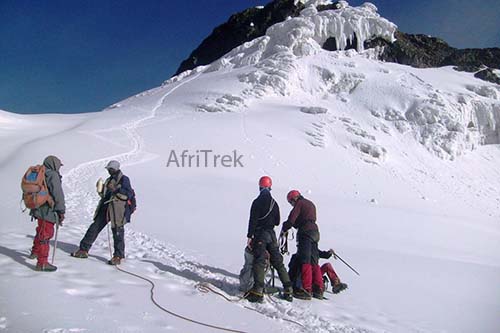
Reaching Margherita Peak requires genuine technical mountaineering, including glacier travel and rope work near the summit, a meaningfully different undertaking from the range’s lower peaks. Elsewhere in the range, Vittorio Emanuele Peak on Mount Speke reaches 4,890 meters, and Edward Peak on Mount Baker reaches 4,843 meters — both offering serious high-altitude trekking without the technical glacier crossing that defines a genuine Margherita summit attempt.
Why “Mountains of the Moon”? The Ancient History Behind the Name
Rwenzori Mountains National Park carries one of Africa’s oldest recorded geographic references. The Greek geographer Ptolemy described snow-capped “Mountains of the Moon” as the source of the Nile as early as the 2nd century AD, a description many historians and explorers later connected directly to the Rwenzori range, given its genuinely unusual combination of equatorial location and permanent glaciation.
This ancient pedigree, combined with the park’s exceptional biodiversity, earned Rwenzori Mountains National Park UNESCO World Heritage Site status in 1994, recognizing it as one of the most ecologically significant mountain ranges on the continent.
Wildlife Species to See at Rwenzori Mountains National Park
Beyond its mountaineering appeal, Rwenzori Mountains National Park shelters a genuinely striking range of wildlife within its varied altitude zones — blue cirque lakes, cascading waterfalls, and the range’s signature otherworldly vegetation.
Expect to encounter elephants, leopards, and chimpanzees at the park’s lower elevations, alongside 18 recorded mammal species, 217 bird species, and 9 reptile species spread across the park’s dramatically shifting habitat zones as altitude climbs.
Mountain Climbing and Trekking Routes in the Rwenzoris
Mountaineering in Rwenzori Mountains National Park is the single experience most visitors come specifically for. Hiking through this range carries you through genuinely distinct vegetation zones, tropical forest, bamboo, heather-lobelia moorland, and finally glacier terrain with magical views over the peaks and surrounding valleys at every elevation change. Reaching a complete summit demands real physical preparation; this isn’t a casual day hike.
Two established routes lead through the range. The Central Circuit Trail requires roughly 7 days, looping through the heart of the range and offering the most complete Rwenzori experience, including the option to summit Margherita Peak itself.
The Kilembe Trail, on the southern side of the park, typically runs 5 days, following a slightly different ecological corridor and reaching high-altitude viewpoints including the popular Mutinda Lookout — without necessarily requiring the full technical summit push.
Travelers with less time can also find shorter 4-day introductory treks along the lower Kilembe route sections, ideal for a genuine taste of Rwenzori hiking without committing to a full expedition.
How Difficult Is Rwenzori Trekking? Fitness and Preparation
Rwenzori Mountains hiking ranks among East Africa’s more physically demanding trekking experiences — considerably tougher underfoot than Kilimanjaro’s well-trodden tourist routes, thanks to Rwenzori’s notoriously boggy, root-tangled lower trails and unpredictable weather even in the dry season.
A reasonable baseline fitness level, prior hiking experience, and for anyone attempting Margherita Peak specifically — basic familiarity with crampons and roped glacier travel are all genuinely important preparation.
Shorter nature-walk-style routes, by contrast, remain accessible to most reasonably fit travelers without technical climbing experience.
Rwenzori Mountains vs. Mount Kilimanjaro: How Do They Compare?
Travelers weighing East Africa’s two great high-altitude destinations often ask how Rwenzori trekking stacks up against climbing Kilimanjaro in neighboring Tanzania.
Kilimanjaro is technically a non-technical trek — no ropes or crampons required even at the summit — and considerably more heavily trafficked, with well-established huts and support infrastructure.
The Rwenzoris, by contrast, offer far fewer crowds, genuinely wilder terrain, permanent equatorial glaciers still clinging to the peaks despite rapid retreat in recent decades, and a technical final push to Margherita Peak that Kilimanjaro simply doesn’t require.
For travelers who’ve already done Kilimanjaro and want a wilder, less-trodden high-altitude challenge, Rwenzori is consistently the next logical step.
Nature Walks and Cultural Encounters in the Rwenzoris
For travelers not chasing a summit, Rwenzori Mountains National Park rewards with genuinely excellent lower-altitude nature walks, exploring the park’s varied plant life at a gentler pace.
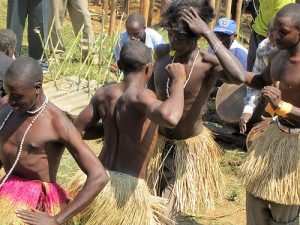
These walks also offer the chance to meet the local Bakonzo communities, learning firsthand about the traditions and culture of the people who’ve called these slopes home for generations.
A cultural encounter rounds out a complete Rwenzori safari experience — visiting Ruboni village specifically offers genuine insight into local drumming, traditional dance, and daily Bakonzo life, alongside the option to learn about community-led conservation efforts protecting the park’s fragile high-altitude ecosystem.
Birdwatching in Rwenzori Mountains National Park
With roughly 217 recorded bird species, Rwenzori Mountains National Park genuinely ranks as one of Uganda’s premier birding destinations.
A dedicated birding tour here rewards visitors with sightings of the striking Rwenzori turaco, slender-billed starling, Lagden’s bush-shrike, blue-headed sunbird, illadopsis, crimson-wings, various barbets, golden-winged sunbird, the barred long-tailed cuckoo, long-eared owl, greenbul, handsome francolin, strange weaver, assorted flycatchers, and the cinnamon-chested bee-eater — a genuinely rewarding list for birders willing to combine mountain scenery with serious avian diversity.
Rwenzori Glaciers and Climate Change: A Vanishing Landscape
One subplot worth understanding before you visit: the Rwenzori range’s famous equatorial glaciers have retreated dramatically over the past century, with scientific studies estimating well over 80% ice loss since the early 1900s and continued rapid retreat projected in coming decades.
For travelers specifically drawn to the idea of standing among snow and ice directly on the equator, visiting sooner rather than later carries genuine weight — a rare, disappearing landscape that won’t look the same in another generation.
Best Time to Visit Rwenzori Mountains National Park
Rwenzori Mountains National Park sits almost directly astride the equator, and most of the range runs considerably wetter than other parts of East Africa.
The rainy season runs from March to May and again from September to mid-December, while the best window for Rwenzori hiking falls during the drier months of June to September, when trails are noticeably more passable and weather conditions more predictable for both nature walks and full mountaineering expeditions.
Accommodation Options at Rwenzori Mountains National Park
Accommodation choices around Rwenzori Mountains National Park include Hotel Margherita, Rwenzori International Hotel, Kitara Lodge, Equator Snow Lodge, and Tropical Savanna Guesthouse — spanning a genuine range from comfortable mid-range options to more rustic lodges suited to trekkers heading out early each morning.
Where Are the Rwenzori Mountains Located?
Rwenzori Mountains National Park sits in western Uganda, roughly 5–6 hours’ drive from Kampala to Kasese, the park’s main gateway town. Most journeys begin either via Entebbe/Kampala to Fort Portal, or via Kampala-Mbarara to Queen Elizabeth National Park before connecting onward to the Rwenzoris — a routing that makes it genuinely easy to combine a Rwenzori trek with classic savanna game viewing on the same broader Uganda itinerary.
Our guide to Uganda’s top wildlife safaris and why Uganda is called the Pearl of Africa both cover how the Rwenzoris fit into the country’s wider natural landscape, including their UNESCO status alongside sites like Bwindi and Mgahinga.
Combining Rwenzori Trekking With the Rest of Your Uganda Safari
Given its location in western Uganda, a Rwenzori Mountains trek pairs naturally with several of the country’s other headline experiences.
Many travelers combine their trek with gorilla trekking further south — see our comparison of gorilla trekking in Bwindi vs Mgahinga for how that leg of the trip fits together — or extend their itinerary to cover Uganda’s five best safari destinations in a single, well-rounded trip.
Hikers wanting to compare the Rwenzoris against Uganda’s other major hiking destination should also see our Mount Elgon National Park guide, while our broader roundup of Africa’s best safari tours places Rwenzori trekking alongside the continent’s other legendary hiking destinations, including Kilimanjaro itself.
FAQ: Rwenzori Mountains National Park
What is the highest peak in the Rwenzori Mountains? Margherita Peak, atop Mount Stanley, at 5,109 meters — Africa’s third-highest summit and Uganda’s highest point.
How long does it take to trek the Rwenzori Mountains? The Central Circuit Trail takes roughly 7 days; the Kilembe Trail typically takes 5 days, with shorter 3–4 day introductory options available on the lower Kilembe route.
Is Rwenzori harder to climb than Kilimanjaro? In several ways, yes — Rwenzori’s trails are notoriously muddier and less developed, and reaching Margherita Peak specifically requires roped glacier travel that Kilimanjaro’s summit doesn’t demand.
When is the best time to visit Rwenzori Mountains National Park? June to September, during the region’s drier season, offers the most passable trails and predictable weather.
Are the Rwenzori glaciers disappearing? Yes — the range has lost well over 80% of its historic ice cover since the early 1900s, with continued retreat expected in the coming decades.
How far is Rwenzori Mountains National Park from Kampala? Roughly 400km, or about 5–6 hours’ drive to the gateway town of Kasese.




Didn’t know there was snow in Uganda!! Seems a trip to Uganda is a full package