
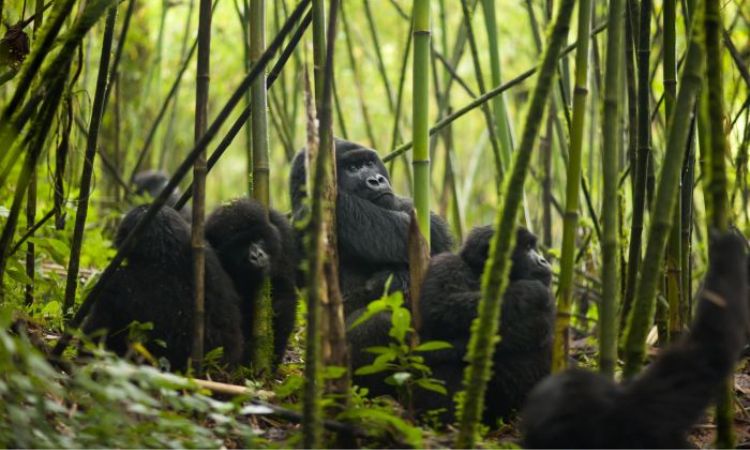
Volcanoes National Park vegetation is one of Africa’s finest examples of Afromontane ecosystem diversity, shaped entirely by altitude. The lowest forest zone, where gorilla trekking takes place is dominated by dense montane rainforest with a multilayered canopy of trees including giant Hagenia abyssinica and hypericum species draped in moss and epiphytes.
As altitude increases, the forest transitions through Neoboutonia woodland, bamboo forest, the primary food source for both mountain gorillas and golden monkeys — Hagenia-Hypericum forest, and eventually into the extraordinary high-altitude zone of giant lobelias (Lobelia wollastonii and Lobelia lanuriensis), giant groundsels (Senecio erici-rosenii), grassland, and the permanent glaciers of Karisimbi’s summit.
Wildlife in Volcanoes National Park extends beyond the headline mountain gorillas to a rich community of forest mammals including golden monkeys, spotted hyenas, black and white colobus monkeys, bushbucks, black-fronted duikers, forest buffaloes, forest elephants, leopards, giant forest hogs, and bush pigs.
The golden monkey, the park’s second most famous primate attraction, is a vibrantly coloured, acrobatic species endemic to the Virunga Mountains and Bwindi ecosystem, listed as Endangered on the IUCN Red List and found only within Volcanoes National Park and a small number of adjacent protected areas.

Birds of Volcanoes National Park number over 180 species, including 16 endemic to the Rwenzori Mountains and 13 endemic to the Virunga Mountain range. Target species for birders on a Volcanoes National Park birding safari include the Rwenzori turaco, Rwenzori double-collared sunbird, Rwenzori batis, Archer’s ground robin, Handsome francolin, Grauer’s rush warbler, dusky crimsonwing, cinnamon-chested bee-eater, grey-throated tit, long-crested eagle, red-faced woodland warbler, and the paradise flycatcher.
The wet season months of March to May and October to November are best for birding in Volcanoes National Park, when breeding activity peaks and migratory species arrive.
Mountain Gorilla Trekking — The Centrepiece of Every Rwanda Safari
Gorilla trekking in Volcanoes National Park begins every morning at the park headquarters in Kinigi, where trekking groups assemble at 7:00 AM for a pre-trekking briefing by park rangers.
Each group of eight visitors is assigned to a specific habituated gorilla family based on permit allocation, and trekking parties then enter the forest with their ranger guide and armed escort.
The duration of the trek to reach the gorilla family varies from thirty minutes to three hours depending on the family’s movement overnight. Once located, the group has one full uninterrupted hour with the gorillas, observing, photographing, and simply being present as the family goes about its morning activities: foraging, playing, nursing infants, grooming.
The silverback’s composure in human presence — the absolute confidence of an animal that has decided these visitors are harmless — is one of the most disarming things a person can witness in the natural world.
This is why every visitor to Volcanoes National Park returns from their trek with the same expression: the specific look of someone who has just encountered something they cannot adequately describe.
Minimum age for gorilla trekking in Rwanda is 15 years. Visitors with colds, flu, or any contagious respiratory illness are not permitted to trek as mountain gorillas share 98 percent of human DNA and are highly susceptible to human diseases.
Golden Monkey Trekking in Volcanoes National Park
Golden monkey trekking is the park’s second most popular primate activity and the most affordable with permits at USD $100 per person for foreign non-residents (USD $80 for foreign residents; USD $65 for East African citizens and Rwandans).
Two habituated golden monkey communities are tracked daily, and the experience delivers encounters with one of Africa’s most visually striking and behaviourally entertaining primates in the bamboo forest habitat that the species depends on.

Combining gorilla trekking and golden monkey tracking in Volcanoes National Park in a two-day visit is one of Rwanda’s finest safari experiences.
Dian Fossey gravesite Hike
The Dian Fossey hike leads trekkers from the park boundary to the site of Fossey’s Karisoke Research Centre and her burial site, where she was interred, per her wishes, alongside the gorillas she spent her life protecting.
The two-hour hike delivers not only historical and emotional resonance but also the opportunity to encounter forest birds, primates, and the montane vegetation of the lower Bisoke slopes.
Dian Fossey hiking permits cost USD $75 for foreign non-residents, USD $60 for foreign residents, and USD $55 for Rwandan and East African citizens
Volcano Climbing
Volcano climbing in Volcanoes National Park is one of Rwanda’s most physically demanding and most scenically rewarding adventures. The three most popular climbs are:
Mount Bisoke — a moderate one-day hike to the crater rim at 3,711 metres, rewarded with views over the crater lake and across the Virunga peaks. Bisoke climbing permits cost USD $75 for foreign non-residents.
Mount Karisimbi — Rwanda’s highest volcano at 4,507 metres and the most demanding of the Virunga climbs, typically completed as a two-day overnight camping expedition. The summit view across the Democratic Republic of Congo, Rwanda, and Uganda on a clear day is one of the continent’s great high-altitude panoramas.
Mount Sabyinyo — a challenging triple-summit climb that offers the unique experience of standing simultaneously in Rwanda, Uganda, and the DRC at the junction point of all three countries’ borders atop the central peak.
Cultural Village Tours
Cultural tours from Volcanoes National Park centre on the Iby’Iwacu Cultural Village near the park boundary, where visitors experience traditional Rwandan cultural performance, cuisine, dance, storytelling, traditional medicine preparation, and the craft traditions that pre-colonial communities developed in the forest’s shadow.
The cultural village experience is an important community development initiative — revenue supports local families and reinforces the connection between Volcanoes National Park’s conservation success and the economic wellbeing of surrounding communities.

Bird Watching Safaris
A birding safari in Volcanoes National Park rewards ornithologists with a high concentration of Albertine Rift endemics in a compact, accessible forest, an experience that complements the primate activities that occupy most of the morning hours.
An afternoon birding walk after a morning gorilla trek is one of the most productive ways to structure a full day in the park.
Nature Walks and Forest Walks
Guided nature walks in Volcanoes National Park offer a gentler, less physically demanding engagement with the forest ecosystem suitable for visitors who want to absorb the park’s botanical and ecological richness without the intensity of gorilla trekking terrain.
Nature walks reveal butterflies, reptiles, amphibians, smaller primates, and the forest’s extraordinary plant diversity in a pace and format that rewards careful observation.
Musanze Cave Tours
The Musanze Caves near the park headquarters are a network of ancient lava tubes extending over several kilometres beneath the volcanic landscape of the Virunga foothills.
A guided Musanze cave tour explores the underground passages, their geological history, and the traditional Rwandan legends associated with these atmospheric subterranean formations.
Twin Lakes Boat Cruise
The Twin Lakes of Bulera and Ruhondo — volcanic crater lakes visible from the park’s approach road offer a beautiful boat cruise experience with views across the lakes to the Virunga volcanoes rising beyond their shores.
The boat cruise is a relaxing counterpoint to the physical exertion of gorilla trekking and volcano climbing, delivering outstanding birdwatching across the lake surface and riparian vegetation
Volcanoes National Park accommodation spans a wider range of quality and price than almost any other gorilla trekking destination in Africa, from basic guesthouses in Musanze town to some of the continent’s most celebrated luxury wilderness lodges.
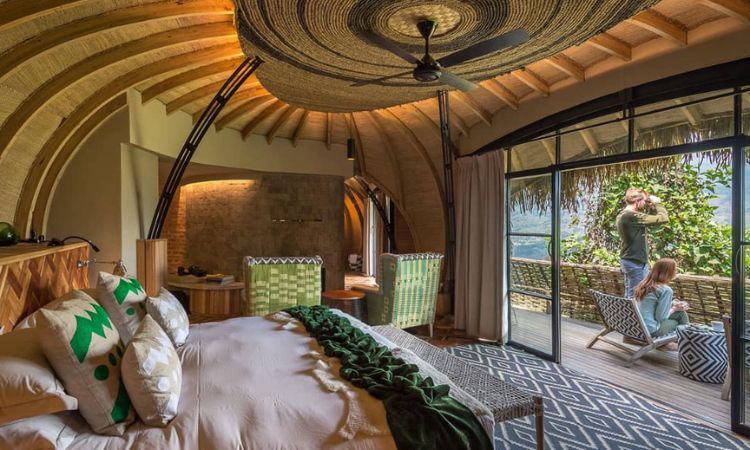
Luxury lodges near Volcanoes National Park include Bisate Lodge — one of Africa’s most acclaimed eco-luxury properties, built into a forested volcanic bowl with sweeping views of the Virunga volcanoes and a reforestation programme of over 50,000 indigenous trees; One&Only Gorilla’s Nest Lodge, delivering the brand’s signature ultra-premium service in a forest setting; Sabyinyo Silverback Lodge, whose revenues fund community development programmes throughout the surrounding parishes; and Virunga Lodge, perched on a ridge above the Twin Lakes with panoramic views that are among the finest of any lodge in East Africa.
Mid-range lodges near Volcanoes National Park include Mountain Gorilla View Lodge, Five Volcanoes Boutique Hotel, Da Vinci Gorilla Lodge, Le Bambou Gorilla Lodge, and Gorilla Solution Lodge each offering comfortable ensuite accommodation with genuine personality and good guiding connections.
Budget accommodation options include Kinigi Guesthouse, Muhabura Hotel, and a range of guesthouses in Musanze town all within reasonable driving distance of the park headquarters and suitable for independent travellers and budget safari guests.
Best Time to Visit Volcanoes National Park
Volcanoes National Park Rwanda can be visited at any time of the year but the dry months of January, February, June, July, August, September and December are the best for Mountain Gorilla Trekking, golden monkeys, hiking the Dian Fossey gravesite, climbing the Virunga Volcanoes and undertaking other nature walks because since the rains are relatively lower, trails tend to be less slippery.
The wet months-March, April, May, October and November that are characterized by muddy and slippery hiking trails. However, birding and butterfly watching is perfect during the wet months.
How to Get To Volcanoes National Park
The drive from Kigali to Volcanoes National Park takes approximately 2 to 3 hours on well-maintained roads through Rwanda’s distinctive thousand-hills landscape.
From Kigali International Airport, the route heads north through Musanze, the nearest significant town, 17 kilometres from the park headquarters — before continuing to Kinigi. Both private vehicle hire and scheduled bus services from Kigali operate this route, with the private vehicle option strongly recommended for flexibility and for guests with premium lodge reservations.
For visitors arriving from Uganda, the Katuna-Chanika border crossing between Uganda and Rwanda connects southern Uganda’s Bwindi Impenetrable Forest area to Volcanoes National Park via a 4-hour drive making a combined Uganda and Rwanda gorilla trekking itinerary practical and popular.
Trekking mountain gorillas in both countries on the same trip encountering two entirely different habituated families in two different parts of the same transboundary mountain ecosystem is one of the finest gorilla safari combinations available.
By air, Rwanda’s national carrier and international airlines connect Kigali’s Bugesera International Airport (the new airport, partially operational) and the existing Kigali International Airport to major hubs in Europe, the Middle East, and East Africa with exceptional frequency for a city of its size.
Kigali’s airport efficiency and the 2-hour road connection to the park make Rwanda one of the most logistically smooth gorilla destinations in the world.
Why Volcanoes National Park Rwanda Deserves Its Place on Every Gorilla Safari List
Volcanoes National Park is not just a gorilla trekking destination. It is a landscape saturated with conservation history, volcanic drama, and the kind of wildlife encounters that permanently alter how you understand what the word “wild” means. It is where Dian Fossey watched gorillas through mountain mist for eighteen years and changed the world’s relationship with a species.
It is where the gorilla population recovered from the edge of extinction. And it is where, every morning at 7 AM, eight visitors at a time walk into the forest and come back an hour later unable to say exactly what has changed — only that something has.
Book your Volcanoes National Park gorilla trekking safari in 2026. The permits are limited. The families are waiting. The forest has room for you.