
Ziwa Rhino Sanctuary – Rhino Trekking Uganda 2026 Top Guide
Ziwa Rhino Sanctuary: Discover Ziwa Rhino Sanctuary Uganda with this complete 2026 guide covering rhino trekking, entrance fees, activities, accommodation, birdwatching, travel tips, conservation efforts, and everything you need to plan an unforgettable visit.
There is only one place in Uganda where you can walk on foot through open savannah, follow a ranger tracking prints and droppings through the bush, and come face to face with a wild southern white rhinoceros at close range. That place is Ziwa Rhino Sanctuary — Uganda’s most important wildlife conservation success story, a remarkable living proof that committed, patient restoration work can bring a species back from national extinction, and one of the finest wildlife encounters available anywhere in East Africa.
In the early 1980s, not a single wild rhino remained in Uganda. Unchecked poaching during the civil unrest of the late 1970s wiped out the country’s populations of both black and white rhinos in Murchison Falls and Kidepo Valley National Parks. By 2005, a restoration project was underway.
Today, Ziwa Rhino Sanctuary is home to a flourishing and growing population of 48 southern white rhinos as of 2026, up from just 6 individuals when the project began making it one of the most celebrated wildlife reintroduction successes in African conservation history.
For visitors planning a Uganda safari in 2026, a stop at Ziwa Rhino Sanctuary is not merely an option, it is the experience that completes the Big Five picture that no other single park in Uganda can provide.
Ziwa Rhino Sanctuary Location: Where Is It and How Far from Kampala?
Ziwa Rhino Sanctuary is located in Nakasongola District, approximately 176 kilometres north of Kampala along the Kampala-Gulu highway, the main arterial road connecting the capital to northwestern Uganda and the primary route to Murchison Falls National Park.
The drive from Kampala takes approximately 3 hours in normal traffic conditions, making Ziwa one of the most accessible major wildlife destinations in Uganda.
The sanctuary’s positioning on the Kampala-Gulu highway is strategically ideal. For tourists travelling north to Murchison Falls National Park, Uganda’s largest and most visited park, Ziwa Rhino Sanctuary sits almost exactly at the midpoint of the journey, making it an organic and deeply rewarding half-day or full-day stopover that adds an entirely different wildlife dimension to any northern Uganda itinerary.
The yellow-signed Ziwa Rhino Sanctuary turnoff sits west of the highway, followed by approximately 4 kilometres of road to the sanctuary gate.
The sanctuary covers 70 square kilometres (7,000 hectares) of mixed savannah, wetland, acacia woodland, and grassland enclosed by an electric perimeter fence.
This habitat variety, open savannah where rhinos graze, lugogo swamp wetlands where shoebill storks nest, and acacia thickets where leopards and other predators move at night — delivers a biodiversity richness that far exceeds what its private sanctuary status might suggest.
The Southern White Rhino Population at Ziwa: Uganda’s Conservation Triumph
Ziwa Rhino Sanctuary was established in 2005 as a joint initiative between the Uganda Wildlife Authority (UWA) and the Rhino Fund Uganda — a collaboration between government and private conservation that has since become a model for wildlife restoration in East Africa.
The sanctuary’s founding population of six southern white rhinos has grown to 60 individuals as of 2026, a rate of population increase that conservation biologists describe as exceptional given the species’ slow reproductive cycle.
The southern white rhino is classified as Near Threatened on the IUCN Red List — a recovery from the species’ near-extinction in the late twentieth century that is one of conservation’s great achievements.
Within Uganda specifically, the restoration from zero wild individuals to a self-sustaining, growing population of 48 represents one of the finest wildlife conservation outcomes on the continent.
The ultimate conservation goal of Ziwa Rhino Sanctuary is not simply to maintain a captive breeding population but to restore wild rhinos to Uganda national parks specifically Murchison Falls and Kidepo Valley where they once roamed freely.
As the Ziwa population grows and individual rhinos are assessed for readiness, the reintroduction programme will begin transferring animals to these larger protected areas, closing the chapter on Uganda’s rhino extinction.
Ziwa Rhino Sanctuary Entry Fees and Ticket Prices for 2026
Ziwa Rhino Sanctuary entry fees are structured to cover park access and conservation operations, with activity fees charged separately for specific guided experiences. The current fees for 2026 season are as follows:
General Park Entry Fee:
- Foreign non-residents: USD $60 per adult
- Foreign non-resident children: USD $30
- Foreign residents: USD $50 per adult
- Foreign resident children: USD $25
- East African Community citizens: UGX 50,000 per adult
- East African Community children: UGX 15,000
Children below 12 years enjoy a 50 percent discount on most activity fees. Fees are payable at the gate or through authorised tour operators. The sanctuary’s entry fee structure reflects its operation as a private conservation reserve managed under UWA oversight — revenue flows directly into rhino security, anti-poaching ranger salaries, veterinary care, habitat management, and the long-term reintroduction programme.
Activity-specific fees for rhino trekking, shoebill canoe excursions, night walks, and guided nature walks are charged additionally to the park entry fee. Contact the sanctuary directly or book through a licensed Ugandan tour operator for the current complete activity rate schedule.
Rhino Trekking at Ziwa: What to Expect During Your Visit
Rhino trekking at Ziwa Rhino Sanctuary is the defining experience of the entire visit and one of the most intimate wildlife encounters available anywhere in Uganda.
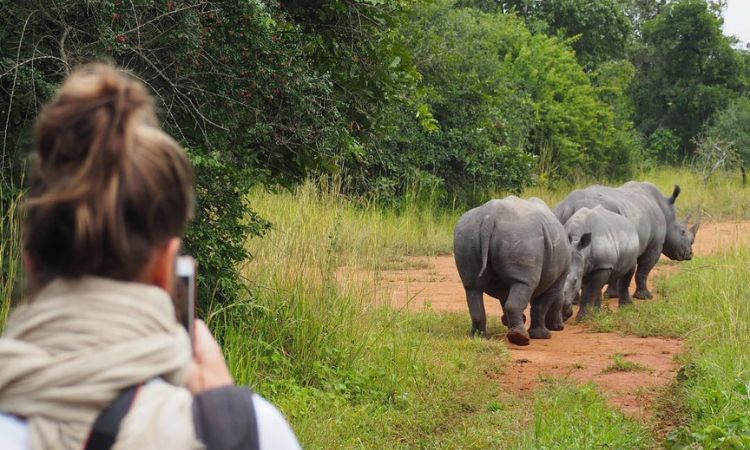
Unlike a game drive where you observe animals from a vehicle, rhino tracking at Ziwa is conducted entirely on foot. You walk through the bush with trained armed rangers who have been monitoring specific rhinos since dawn, following footprints, fresh droppings, and broken vegetation to locate the animals in real time.
The rhino tracking experience typically lasts one to two hours from departure to encounter, though the actual time in the field varies with the rhinos’ location on any given day.
Trained rangers lead small groups through the sanctuary, and once you find the rhinos, you can observe and photograph them from a safe distance of approximately 7 to 10 metres, close enough to see the texture of their skin, the detail of their horns, and the extraordinary prehistoric solidity of an animal that has existed in essentially the same form for millions of years.
Southern white rhinos are not naturally aggressive in the way that black rhinos can be, and the rangers at Ziwa have years of experience reading individual animals’ behaviour and mood.
Provided visitors follow the tracking guidelines, staying in a tight group, moving quietly, making no sudden movements, and following ranger instructions immediately. The experience is safe, controlled, and utterly unforgettable.
Early morning and late afternoon are the best times for rhino trekking at Ziwa, when temperatures are cooler and the rhinos are more active and easier to approach.
Midday heat drives the rhinos into denser shade, making encounters shorter and tracking more complex. Visitors planning a half-day stopover at Ziwa on the way to Murchison Falls should time their arrival for 7:00 to 8:00 AM to maximise tracking quality.
Beyond the rhinos themselves, the bush trek delivers encounters with Uganda kobs, bushbucks, oribis, waterbucks, and various bird species that share the open savannah — giving the rhino track an added wildlife dimension that makes the experience richer than a single-species encounter.
With over 65 trained armed game rangers working in Ziwa for security and guiding, the entire operation runs with a professional rigour that gives visitors complete confidence in both the safety and the quality of the experience.
Other Wildlife at Ziwa Rhino Sanctuary
Ziwa Rhino Sanctuary wildlife extends well beyond its famous rhino population. The sanctuary’s 70 square kilometres of electric-fenced habitat supports approximately 40 mammal species across its savannah, wetland, and woodland zones.
Large mammals found at Ziwa alongside the rhinos include hippos in the Lugogo Swamp waterways and adjacent wetlands, Nile crocodiles basking along swamp edges, leopards that patrol the wooded sections of the sanctuary and are most frequently encountered on night walks, waterbucks, Uganda kobs, bushbucks, elands, oribis, and warthogs.

The black and white colobus monkeys and olive baboons are common in the riverine and woodland areas, and their presence gives Ziwa a primate dimension that surprises many first-time visitors who come expecting only rhinos.
The sanctuary’s status as a self-contained ecosystem, enclosed and carefully managed, means wildlife densities are high relative to the area, and encounters during the rhino trek and guided nature walks are frequent and varied.
Bird Watching at Ziwa Rhino Sanctuary: 350+ Species in Outstanding Habitats
With over 350 documented bird species, Ziwa Rhino Sanctuary is one of Uganda’s most rewarding birding destinations — a fact that many visitors discover only after arriving primarily for the rhinos.
The sanctuary’s mosaic of open savannah, papyrus swamp, riverine forest, and acacia woodland creates a habitat diversity that supports an exceptional range of species across every ecological guild.
The shoebill stork is Ziwa’s most celebrated avian attraction and one of Africa’s most sought-after birds for serious birders worldwide.
The Lugogo Swamp within the sanctuary provides ideal shoebill habitat — dense papyrus stands adjacent to open water and guided shoebill trekking at Ziwa via canoe is one of East Africa’s finest opportunities to observe this remarkable prehistoric-looking bird at close range.
The shoebill is classified as Vulnerable by the IUCN, and Uganda is one of the best countries in Africa to see it — with Ziwa’s managed canoe access delivering viewing quality that surpasses most other shoebill sites.
Other notable bird species at Ziwa Rhino Sanctuary include the African fish eagle, African crowned eagle, African green pigeon, saddle-billed stork, grey-crowned crane, Ross’s turaco, white-crested turaco, giant kingfisher, pied kingfisher, African pygmy kingfisher, purple heron, African darter, African open-billed stork, sooty falcon, tawny eagle, brown parrot, broad-billed roller, sacred ibis, hammerkop, cattle egret, African jacana, African black crake, red-necked falcon, Abyssinian ground hornbill, cardinal woodpecker, thick-billed honeyguide, red-headed bluebill, wattled lapwing, crested francolin, speckled mousebird, dusky tit, and many others.
There are four designated birding trails within the sanctuary, each targeting different habitat types and species assemblages. Early mornings and late afternoons deliver the highest activity levels and the best light for photography.
For dedicated Uganda birding safari visitors, Ziwa Rhino Sanctuary deserves a full morning specifically for birding — ideally combining a shoebill canoe excursion at dawn with a walk along one of the savannah birding trails mid-morning.
Activities at Ziwa Rhino Sanctuary: Everything You Can Do
Rhino Trekking on Foot
The rhino tracking experience described above is the centrepiece of every Ziwa visit — an on-foot guided trek to observe wild southern white rhinos at close range, led by armed, trained rangers through the sanctuary’s open savannah and bush. This is the only place in Uganda where you can see wild rhinos, making it an irreplaceable experience on any Uganda safari.
Shoebill Canoe Excursion
The shoebill canoe trip at Ziwa takes visitors by dugout or motorised canoe through the Lugogo Swamp to locate shoebill storks in their papyrus nesting habitat.
This is one of the finest and most consistent shoebill viewing opportunities in East Africa, and the canoe journey itself is a beautiful passage through a functioning wetland ecosystem alive with herons, kingfishers, jacanas, and aquatic mammals including hippos and crocodiles.
Guided Day Nature Walks
Guided nature walks at Ziwa Rhino Sanctuary explore the sanctuary’s habitat diversity on foot with trained guides who provide detailed interpretation of the mammals, birds, reptiles, plants, and ecological relationships encountered along the trail.
The nature walk covers different terrain from the rhino trek, including the woodland edges and grassland margins where bushbucks, elands, waterbucks, and Uganda kobs are most frequently encountered.
The guides’ knowledge of the sanctuary’s individual animals — built over years of daily observation — gives these walks a depth of wildlife understanding that few other East African nature walks can match.
Night Walks
Night walks at Ziwa Rhino Sanctuary reveal an entirely different dimension of the ecosystem — nocturnal creatures, night sounds, and the atmosphere of an African savannah after dark.
The night walk regularly delivers sightings of leopards — which become active after dark and are frequently encountered in the sanctuary’s wooded sections alongside pottos, bush babies, owls, African civets, and a variety of nocturnal reptile species. For visitors who have spent daylight hours tracking rhinos and birding, a night walk adds a thrilling final dimension to a full Ziwa experience.
Bird Watching Safaris
The birding experience at Ziwa is a full activity in its own right, not merely a by-product of the rhino trek. Four designated birding trails cover the sanctuary’s major habitat zones, and a dedicated half-day birding session with one of the sanctuary’s specialist birding guides can deliver sightings of 80 to 100 species including multiple target birds for serious listers.
Conservation Education Tour
A rhino conservation education experience at Ziwa explains the history of Uganda’s rhino extinction, the design and implementation of the reintroduction programme, the biology of the southern white rhino, the anti-poaching security infrastructure that protects the herd, and the long-term reintroduction plans for Murchison Falls and Kidepo.
For visitors with children, school groups, or anyone interested in the mechanics of conservation in action, this education component transforms a wildlife visit into a genuinely illuminating learning experience.
Ziwa Rhino Sanctuary as a Big Five Stopover on the Way to Murchison Falls
One of the most compelling reasons to include Ziwa Rhino Sanctuary in a northern Uganda safari itinerary is its role in completing the Big Five experience that Uganda’s individual national parks cannot deliver alone.
Murchison Falls National Park offers lions, elephants, buffalos, hippos, and giraffes in abundance — but no rhinos. Queen Elizabeth National Park delivers outstanding big game diversity but no rhinos. Kidepo Valley National Park in the far northeast is arguably Uganda’s finest overall wildlife destination but still no rhinos.
Ziwa is the only place in Uganda where you can see wild rhinos making it the mandatory piece of the Big Five puzzle for any Uganda safari guest who wants to tick all five of the continent’s most iconic megafauna within a single country.
The sanctuary’s location along the Kampala-Gulu highway places it perfectly on the road to Murchison Falls, turning what would otherwise be a long featureless transit into a wildlife encounter of genuine quality and significance.
A combined Ziwa Rhino Sanctuary and Murchison Falls National Park itinerary is one of Uganda’s most popular safari formats, typically structured as a two-night Murchison Falls stay with a half-day or full-day Ziwa stopover on either the outbound or return leg.
This combination delivers rhinos, lions, elephants, giraffes, hippos, the dramatic Murchison Falls waterfall, a Nile River boat cruise, and the extraordinary shoebill stork, one of East Africa’s finest safari itineraries by any measure.
Best Time to Visit Ziwa Rhino Sanctuary in 2026
Ziwa Rhino Sanctuary is open and rewarding year-round. The southern white rhino does not migrate or seasonally change location, the herd is present every day of the year within the sanctuary’s boundaries, tracked daily by rangers who maintain continuous knowledge of every individual animal’s position. This means there is genuinely no wrong time to visit.
That said, the dry seasons — January to February and June to September offer the easiest tracking conditions: firmer ground, lower grass that makes visual contact easier, and cooler morning temperatures that keep the rhinos more active for longer.
Early morning visits during dry season deliver the finest rhino tracking experience and the most productive birdwatching conditions.
The wet season — March to May and October to November brings dramatically lush green vegetation and active breeding bird behaviour, making these months exceptional for birding at Ziwa.
Shoebill sightings in the Lugogo Swamp are excellent year-round. Rain typically falls in afternoon showers rather than all-day events, so morning visits remain productive regardless of season.
Where to Stay at Ziwa Rhino Sanctuary: Accommodation Options
Ziwa Rhino Sanctuary accommodation is available within and near the sanctuary for visitors who want to experience more than a day visit — particularly valuable for birders who want access to dawn and dusk activity windows across multiple days.
Amuka Safari Lodge is the premier upmarket accommodation option near Ziwa, located approximately 12 kilometres from the sanctuary and offering comfortable, well-appointed facilities with a beautiful swimming pool. Guests staying at Amuka combine Ziwa activities with the lodge’s own birdwatching access and savannah setting.
Within the sanctuary itself, accommodation includes luxury chalets with a swimming pool for guests who want maximum convenience and proximity to early morning activities.
Budget accommodation in the form of bandas and dormitory-style rooms provides affordable overnight access — ideal for independent travellers, researchers, and school groups. A refurbishment programme has been ongoing for the budget rooms and guesthouse.
Camping is available at designated, well-equipped campsites within the sanctuary boundaries, with armed guards stationed nearby throughout the night — essential given the leopard and other wildlife presence within the electric fence.
How to Get to Ziwa Rhino Sanctuary
Getting to Ziwa Rhino Sanctuary from Kampala is straightforward along one of Uganda’s main highways.
The sanctuary is 176 kilometres north of Kampala on the Kampala-Gulu highway — Uganda’s main northern arterial road. The drive takes approximately 3 hours from the city centre in normal traffic conditions.
The route passes through Luwero and Nakasongola District, with the yellow Ziwa Rhino Sanctuary signpost appearing on the west (left-hand) side of the highway for northbound travellers. From the highway turnoff, it is approximately 4 kilometres to the sanctuary gate.
For visitors arriving from Entebbe International Airport, add approximately 40 minutes to the Kampala departure time. For visitors travelling as part of an organised tour with transport, the driver will be familiar with the route and the turnoff.
There is no scheduled air service to Ziwa. The sanctuary is best reached by private vehicle — a standard saloon car is adequate for the highway and access road, and a 4×4 is not required.
Self-drive visitors following the Kampala-Gulu road will find Ziwa a natural and logical first stop on any northern safari itinerary.
Why Ziwa Rhino Sanctuary Belongs on Every Uganda Safari
The rhinos of Ziwa are living proof of what patient, sustained, professionally managed conservation can achieve. From six individuals in 2005 to forty-eight in 2025, from national extinction to a growing, healthy population with a reintroduction programme that will eventually return wild rhinos to Murchison Falls and Kidepo — this is conservation at its most inspiring, and your visit funds it directly.
Walking through the bush on a cool morning, following the rangers’ quiet signals, and then standing ten metres from an adult southern white rhino as it grazes with slow, ancient indifference to your presence — this is the kind of wildlife encounter that reorders your sense of what Africa is capable of when the right people commit to protecting it. It lasts a morning. It stays with you for a lifetime.
Plan your Ziwa Rhino Sanctuary visit today — whether as a standalone day trip from Kampala, a Big Five stopover on the road to Murchison Falls, or an overnight stay that lets you experience dawn rhino tracking and shoebill birding in the same extraordinary morning.