

Mountain Gorillas; 12 Fascinating Facts To Wow Your Friends
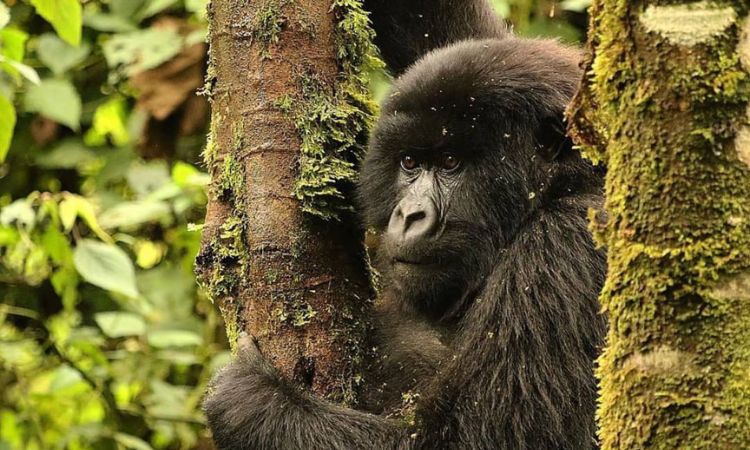
Get to know the interesting facts about mountain gorillas! If you are curious about mountain gorilla size, habitat, diet, behaviors and lifespan, here are 12 facts that may surprise you.
12 Facts About Mountain Gorillas
Curious about mountain gorilla facts — their size, diet, habitat, behavior, and lifespan? Here are 12 genuinely fascinating facts about Gorilla beringei beringei, the largest living primate on Earth and one of Africa’s greatest conservation success stories.
1. Mountain Gorillas Share Over 98% of Their DNA With Humans
Perhaps the most striking of all mountain gorilla facts: this species shares more than 98% of its DNA with humans, making it one of our closest living relatives alongside chimpanzees and bonobos. Scientifically known as Gorilla beringei beringei, this genetic closeness explains everything from their complex social bonds to the very reason gorilla trekking encounters feel so genuinely moving.
Scientific Classification:
Scientific name: Gorilla Beringei Beringei
Kingdom: Animalia
Phylum: Chordata
Class: Mammalia
Order: Primates
Suborder: Haplorhini
Infraorder: Simiiformes
Family: Hominidae
Tribe: Gorillini
Genus: Gorilla
2. Mountain Gorillas Are the Largest Primates on Earth
Mountain gorilla size is genuinely staggering. A mature male can weigh up to 390 pounds, while mature females typically weigh between 240 and 250 pounds making mountain gorillas the largest living primate species on the planet, dwarfing every other great ape by sheer mass.
3. Their Arm Span Is Longer Than Their Height
Mountain gorilla height and arm span don’t follow human proportions. Standing upright, adult mountain gorillas typically measure around 4.5 to 5.5 feet, but their arm span, measured fingertip to fingertip, can stretch to an astonishing 7 to 9 feet, a physical adaptation that supports their distinctive knuckle-walking movement through dense forest terrain.
4. Mountain Gorillas Are Found in Only Two Wild Populations on Earth
Mountain gorilla location is remarkably limited for a species with a global population over 1,000. One population lives across the Virunga volcanic mountains, spanning three national parks: Mgahinga Gorilla National Park in southwestern Uganda, Volcanoes National Park in northwestern Rwanda, and Virunga National Park in the eastern Democratic Republic of Congo.
The second, larger population lives entirely within Uganda’s Bwindi Impenetrable National Park, which alone shelters close to half the world’s total mountain gorilla population. Our guide on where mountain gorillas are found breaks down this geography in more depth.
5. Mountain Gorillas Live in Tight-Knit Family Groups Led by a Silverback
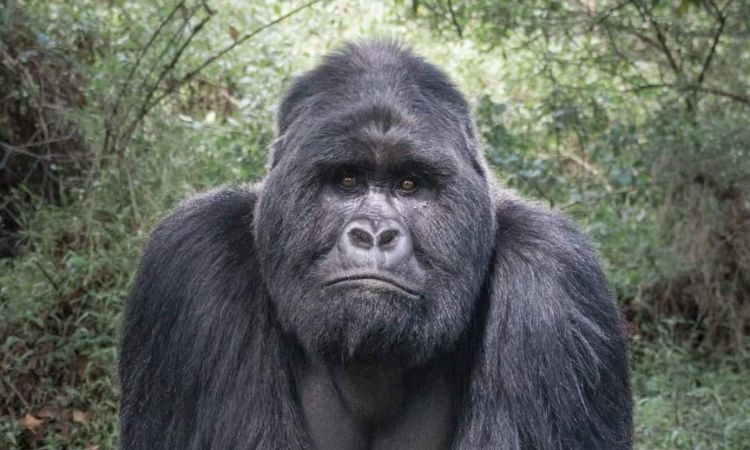
Mountain gorilla social structure centers on cohesive family groups, typically numbering around 30 individuals, though troop size varies. Each group is led by a dominant adult male known as a silverback, named for the distinctive band of silver-grey hair that develops across his back with age.
The silverback protects the group, decides when and where to travel, schedules feeding trips, and settles disputes, with the rest of the troop made up of adult females, juveniles, and infants who typically remain close to him throughout the day.
6. Female Mountain Gorillas Begin Reproducing Around Age 10
Mountain gorilla reproduction follows a genuinely slow, deliberate rhythm. Females reach reproductive maturity around 10 years old, carrying a single infant (twins are rare) after a gestation period of 8 to 9 months.
Over a lifetime, a female mountain gorilla will typically give birth to somewhere between two and six offspring, a slow reproductive rate that makes every successful birth genuinely significant to the species’ overall population recovery.
7. A Silverback Can Eat Up to 30 Kilograms of Vegetation Daily
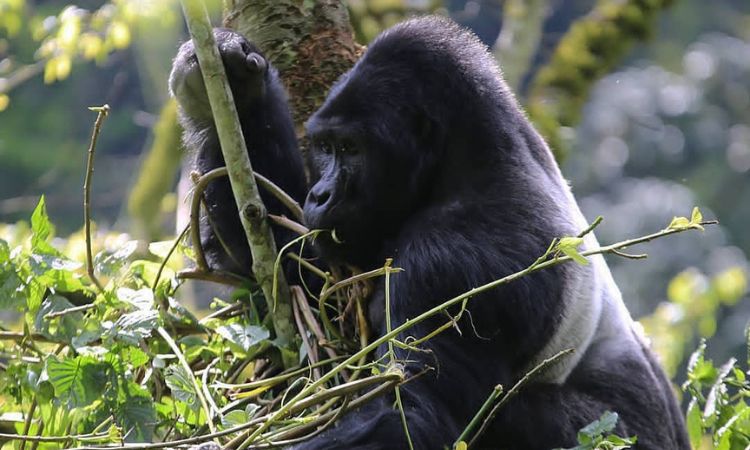
Mountain gorilla diet is almost entirely herbivorous, built around leaves, stems, wild celery, bamboo shoots, and occasional fruit. A large adult male can consume as much as 18 to 30 kg (40–66 lbs) of vegetation per day, spending six to eight hours simply foraging and feeding to sustain his enormous body size, one of the reasons gorilla families rarely travel far from a good feeding area on any given day.
8. Every Mountain Gorilla Has a Unique Nose Print
Just as no two human fingerprints are identical, no two mountain gorillas share the same nose print — the specific pattern of wrinkles and creases above their nostrils is unique to each individual.
Researchers and trackers actually use these nose prints as a primary method of identifying and monitoring specific gorillas within a habituated family over time, a detail most visitors never expect to learn before their first trek.
9. Mountain Gorillas Can Live 35 to 40 Years in the Wild
Mountain gorilla lifespan in the wild typically runs 35 to 40 years, with some individuals living even longer under close conservation monitoring.
Silverbacks generally reach peak physical strength and leadership status in their prime adult years, often retaining their position at the head of a family group for well over a decade.
10. Mountain Gorillas Are the Only Great Ape Species With a Growing Population
Unlike every other great ape species on Earth, the global mountain gorilla population is actually increasing rather than declining, a genuinely rare conservation success story. From a low point of roughly 254 individuals in the 1980s, numbers have climbed to over 1,000 today, a recovery driven by decades of anti-poaching patrols, habitat protection, and tourism revenue that directly funds conservation work across Uganda, Rwanda, and the DRC.
11. Chest-Beating Is a Genuine Form of Communication, Not Just Aggression
Contrary to popular belief, a silverback’s famous chest-beating display isn’t purely an aggressive act, it’s a form of long-distance communication, used to assert dominance, warn off rival males, or simply announce a group’s location to neighboring gorilla families.
Combined with over a dozen distinct vocalizations, from soft grunts to sharp barks, mountain gorillas maintain a genuinely sophisticated communication system within and between family groups.
12. Seeing Mountain Gorillas Requires a Permit — and Directly Funds Their Protection
The final essential fact: mountain gorillas can only be viewed in the wild through an official, government-issued gorilla trekking permit, costing $800 in Uganda and $1,500 in Rwanda.
Rather than a simple entry fee, this permit revenue is one of the primary funding sources behind the anti-poaching and habitat protection efforts responsible for fact #10 above — meaning every trekker who visits a mountain gorilla family becomes a direct contributor to the species’ ongoing recovery.
Our guides on how to book gorilla permits and the full cost of gorilla trekking walk through exactly what this covers and how to plan your own trek.
Related Mountain Gorilla & Gorilla Trekking Guides
- Gorilla Safaris: Gorilla Trekking Tours in Uganda and Rwanda
- Where Are Mountain Gorillas Found?
- Mgahinga Gorilla National Park: Facts, Activities & Location
- Gorilla Trekking in Bwindi vs Mgahinga: Which One Is Better?
- How to Book Gorilla Permits in Uganda & Rwanda
- The Cost of Gorilla Trekking
- Gorilla Trekking Rules
- 5 Days Gorilla Trekking Uganda Safari





Reference: Wikipedia.
NOTE: Did you know!!!
If you are interested in meeting these gentle giants in their natural habitat, you will need to acquire a gorilla permit. Mountain gorilla permits are as cheap as $700 on Uganda Gorilla Safari (starting 1st-July-2020) and $1500 in Rwanda which also require prior bookings for a fascinating gorilla safari of a lifetime.

3 Days Gorilla Trekking Safari
This is an Africa wildlife safari leading you to Bwindi impenetrable national park for mountain gorilla trekking and Batwa community walk. Bwindi inhabits half of the world’s remaining mountain gorillas and it is located in the southwestern part of Uganda at the edge of the rift valley...


Pingback: Mountain Gorilla Baby Boom In Bwindi National Park Uganda
Very helpful blog. The mountain gorillas are truly amazing creatures. I have tracked them before and i would like to go again. Thanks for sharing wonderful views