
Virunga National Park – D.R Congo’s sole Mountain Gorilla Trekking Safari Park
Virunga National Park is one of the most extraordinary protected areas on earth, Africa’s oldest national park, the continent’s most biologically diverse, home to more than 400 mountain gorillas, two active volcanoes, 218 mammal species, and over 700 bird species in a landscape that stretches across 7,800 square kilometres of eastern Democratic Republic of Congo.
It is, by almost every scientific measure, the most richly endowed park in Africa — and it is the park that has, more than any other, spent the last century fighting for its survival against armed conflict, civil instability, poaching, and the sheer difficulty of protecting a precious ecosystem at the intersection of some of the most geopolitically complex territory on the continent.
For travellers researching gorilla trekking in the DRC, and specifically mountain gorilla trekking in Virunga National Park, the critical 2026 update must be stated clearly and directly: Virunga National Park has been closed to tourists since March 2020, initially due to COVID-19, and subsequently due to major security concerns following the M23 rebel movement’s capture of Goma in 2025 and the ongoing armed conflict in the park’s surrounding region.
As of 2026, gorilla trekking in Virunga is not available to book, and travel to the area is strongly inadvisable. The park’s own communications confirm this status, and international travel advisories from the UK, US, EU, and Australia maintain do-not-travel recommendations for eastern DRC.
 This guide presents Virunga National Park in full — its extraordinary ecology, wildlife, history, and pre-closure activities, while directing anyone who wants to trek mountain gorillas in 2026 toward the two safe, open, world-class alternatives: Bwindi Impenetrable National Park in Uganda and Volcanoes National Park in Rwanda.
Important 2026 Safety Notice: Virunga National Park Closure Status
Virunga National Park closed to visitors in March 2020. Despite hopes for reopening as the security situation evolved, the park has not reopened for tourism as of June 2026.
The M23 militant group captured Goma, the gateway city for all Virunga tourism operations in 2025, and fighting continues in the surrounding region.
The gorilla trekking detailed in pre-2020 documentation is not available, and visiting the area carries genuine and serious personal safety risk.
For travellers seeking mountain gorilla trekking in 2026, the alternatives are outstanding:
Uganda’s Bwindi Impenetrable National Park hosts approximately 459 mountain gorillas, half the world’s population across four trekking sectors with gorilla permits at USD $800 per person. The park is fully open, safe, and delivers the finest value gorilla trekking experience in the world.
Rwanda’s Volcanoes National Park hosts 12 habituated gorilla families in the same Virunga Massif ecosystem as Virunga National Park DRC, with gorilla permits at USD $1,500 per person (or $1,050 low season with multi-park combination). The park is fully open, safe, and the most accessible gorilla destination from an international airport.
The DRC also offers mountain gorilla trekking at Kahuzi-Biega National Park near Bukavu where Eastern Lowland Gorillas (a different subspecies) can be tracked at USD $400 per permit in generally safer conditions than the Virunga region. This remains an active, bookable option for adventurous travellers.
Virunga National Park: Africa’s First and Most Biodiverse Protected Area
Virunga National Park was gazetted in 1925 as Albert National Park making it not only Africa’s oldest national park but one of the world’s first, established under Belgian colonial administration at a time when the concept of formally protecting wild land was still a radical conservation idea.
It was designated a UNESCO World Heritage Site in 1979 in recognition of its extraordinary biodiversity, and it holds the additional distinction of being a Ramsar Convention wetland since 1996, one of the internationally recognised wetlands of global ecological significance.
The park extends across 7,800 square kilometres (780,000 hectares) in the Albertine Rift Valley of eastern DRC, bordering Volcanoes National Park in Rwanda to the south and the Rwenzori Mountains National Park in Uganda to the north.
This positioning within the Albertine Rift — the western branch of the Great Rift Valley, widely considered the world’s most biodiverse terrestrial region, explains Virunga’s extraordinary species richness.
The park is currently managed by the Institut Congolais pour la Conservation de la Nature (ICCN), which operates in collaboration with the Virunga Alliance, a coalition of conservation organisations including the Virunga Foundation that has worked to protect the park through decades of instability.
Flora and Fauna in Virunga National Park
Flora of Virunga National Park: Botanical Richness Across Five Ecological Zones
Virunga National Park plant life encompasses over 2,077 documented plant species, including 230 species endemic to the Albertine Rift, found nowhere else on earth — and 264 tree species distributed across the park’s five distinct vegetation zones.
The park’s extraordinary altitude range — from approximately 680 metres in the Rwindi lowlands to 5,109 metres at the summit of Mount Stanley on the shared Rwenzori range — creates an ecological gradient spanning tropical lowland savannah at the base, transitioning through montane rainforest, bamboo zone, Hagenia-Hypericum forest, ericaceous heath, and the extraordinary Afro-alpine zone of giant lobelias, giant groundsels, and permanent glaciers at the highest elevations.
The bamboo zone is particularly significant for mountain gorilla habitat in Virunga. The dense stands of mountain bamboo that cover the middle-altitude slopes of the Virunga volcanoes and the Rwenzori foothills provide both food and shelter for the gorilla population.
The Hagenia-Hypericum forest, draped in lichens and cloud forest moss, is the primary habitat for gorilla trekking encounters in Virunga’s southern sections.
Wildlife in Virunga National Park: 218 Mammal Species in One Protected Area
Virunga National Park wildlife encompasses a mammal community so diverse that it surpasses virtually every other protected area in Africa in species richness.
The park’s 218 documented mammal species reflect the ecological breadth of its five vegetation zones, spanning forest, savannah, wetland, and montane habitats.
The mountain gorillas of Virunga National Park are the park’s most celebrated residents. More than 400 mountain gorillas live within Virunga’s boundaries — a population that, combined with the gorillas of Bwindi Impenetrable Forest and Volcanoes National Park, forms the entire global mountain gorilla population.
Prior to closure, eight habituated gorilla groups — including the Humba, Munyanga, Bageni, Lulengo, Nyakamwe, Mapuwa, Kabirizi, and Rugendo families, were available for tourism. These families remain within the park under ranger protection, though public access is currently suspended.
Other remarkable mammals in Virunga include the Okapi — one of Africa’s most enigmatic and rarest animals, a forest-dwelling relative of the giraffe found only in the DRC’s Congo Basin forests — forest and savannah elephants, hippopotamuses in the Ishasha River and Lake Edward sections, Congolese buffalo, chimpanzees, leopards, lions in the Rwindi and Ishasha savannah sectors, blue monkeys, red-tailed monkeys, Central African red colobus monkeys, Dent’s Mona monkeys, De Brazza’s monkeys, grey-cheeked mangabeys, olive baboons, Uganda kobs, topis, waterbucks, warthogs, giant pangolins, giant forest hogs, aardvarks, water chevrotains, and numerous antelope species across the full habitat range.

Virunga National Park reptile diversity is the highest of any protected area in Africa — with over 109 reptile species including Nile crocodiles, monitor lizards, multiple chameleon species, geckos, and a remarkable range of snake species inhabiting the park’s diverse habitat mosaic.
Amphibians in Virunga number over 78 species — the highest count within the Albertine Rift Valley reflecting the park’s extensive wetland habitats, forest streams, and the moisture-rich Afromontane environment.
Birds of Virunga National Park: 706 Species in the Albertine Rift
Virunga National Park is one of Africa’s premier birding destinations, with over 706 documented bird species representing an extraordinary proportion of the Albertine Rift’s avian diversity.
The park’s position at the centre of the Albertine Rift Endemic Bird Area means that a significant proportion of the world’s rarest and most geographically restricted bird species find critical habitat within its boundaries.
Target species for birding in Virunga include the Rwenzori turaco, Archer’s ground robin (endemic to the Albertine Rift), Rwenzori batis, cinnamon-chested bee-eater, mountain yellow warbler, black-throated wattle-eye, chestnut-throated apalis, red-throated alethe, red-faced woodland warbler, strange weaver, African dusky flycatcher, African goshawk, blue-spotted wood dove, black-billed turaco, yellow-whiskered greenbul, white-headed wood hoopoe, black and white casqued hornbill, pin-tailed whydah, African paradise flycatcher, yellow-rumped tinkerbird, and mountain buzzard.
These 706 species across the park’s savannah, forest, wetland, bamboo, and high-altitude habitats make Virunga arguably the finest birding national park on the African continent by sheer species count.
The Two Active Volcanoes of Virunga: Nyiragongo and Nyamuragira
Virunga National Park’s two active volcanoes are among the park’s most dramatic and most scientifically significant features — and they are among the reasons the park’s geology is unlike any other protected area in Africa.
Mount Nyiragongo stands at 3,470 metres above sea level and contains the world’s largest permanent lava lake, a churning, glowing pool of molten rock at the volcano’s crater summit that has been in near-continuous eruption since 1882.
The Nyiragongo lava lake’s fluid, extremely low-viscosity lava, the most fluid naturally occurring lava on earth makes Nyiragongo one of the world’s most dangerous volcanoes for the densely populated Goma region at its base.
The Nyiragongo volcano hike was, prior to the park’s closure, one of Africa’s most extraordinary adventure experiences: an 8-kilometre ascent to the crater rim followed by an overnight stay in basic huts at the summit, watching the lava lake glow in the darkness below.
Mount Nyamuragira — Africa’s most active volcano — sits 15 kilometres northwest of Nyiragongo and has erupted more than 40 times since 1882. Its eruptions are characteristically effusive rather than explosive, producing long lava flows that have shaped the park’s northern landscape over centuries.
The combination of these two continuously active volcanic systems creates a unique geological dynamism that has both enriched Virunga’s soil fertility supporting the bamboo and forest productivity that feeds its extraordinary wildlife and posed ongoing challenges to the communities and conservation infrastructure of the surrounding region.
Tourist activities in Virunga National Park
Gorilla Trekking in Virunga National Park
Gorilla trekking at Virunga National Park was, before the park’s March 2020 closure, one of Africa’s most adventurous and most affordable mountain gorilla experiences.
The Virunga gorilla trekking permit cost was set at USD $400 per person per trek, the lowest mountain gorilla permit price in the world, approximately half of Uganda’s $800 and one-quarter of Rwanda’s $1,500, making the DRC the most affordable country for mountain gorilla trekking before the security situation rendered it inaccessible.
Eight habituated gorilla families were available for daily trekking in the park’s southern sector near Bukima and Djomba, accessible from Goma and Rutshuru Town.
Groups of up to six trekkers per gorilla family per day spent one hour with the gorillas after finding them on foot with trained rangers and armed security escorts — an escort requirement reflecting the park’s security complexity even during its operational period.
The Virunga mountain gorilla population remains within the park, monitored by ICCN rangers who maintain presence in the park despite the tourism closure.
The continued ranger patrols — funded in part by international conservation organisations including the Virunga Foundation are critical to preventing poaching during the extended closure period.
The gorillas’ survival depends on this protection infrastructure functioning even when no tourism revenue is flowing.
When will Virunga National Park reopen? As of June 2026, no confirmed reopening date has been announced. The security situation requires a sustained period of stability — particularly in the Goma region and the park’s southern and eastern sectors before responsible tourism operators can safely resume trekking programmes. The Virunga National Park website is the authoritative source for any future reopening announcement.
Chimpanzee Habituation in Virunga National Park
Chimpanzee habituation in Virunga began in 1987 under the observation of Frankfurt zoologist Christophe Boesch, making it one of the earliest formal chimpanzee habituation programmes in Central Africa.
Unlike the highly developed chimpanzee tourism infrastructure of Uganda’s Kibale National Park, where 1,500 chimpanzees are distributed across 13 habituated communities — Virunga’s chimpanzee habituation programme is less formalised for tourism purposes, operating primarily in a research context.
The park’s chimpanzee population inhabits the Rwenzori foothills in the north and the montane forest sections of the southern park boundary near the Mikeno sector.
Visit Senkwekwe Gorilla Orphanage: Care for Congo’s Most Vulnerable Gorillas
Immediately adjacent to the Mikeno Lodge at the Rumangabo park headquarters, the Senkwekwe Centre for Mountain Gorillas is the world’s only sanctuary dedicated specifically to orphaned mountain gorillas.
Named after Senkwekwe, a silverback gorilla killed by poachers in 2007 in one of the most widely reported gorilla killings in conservation history, the centre provides permanent care for mountain gorillas whose human habituation prevents reintegration into wild groups.
The Senkwekwe Centre currently houses several individuals who were orphaned through poaching, war-related violence, or the capture of their family groups.
Each gorilla has a dedicated ranger who maintains a close, daily relationship with the animal — effectively serving as a surrogate family member to compensate for the social isolation that captivity imposes on an animal whose entire natural psychology is built around group life.
When the park was open to visitors, a visit to Senkwekwe Gorilla Orphanage was one of the most emotionally powerful experiences Virunga offered, a close-range encounter with gorillas whose histories were simultaneously heartbreaking and a testament to the dedicated rangers who cared for them.
The orphanage remains operational despite the tourism closure, sustained by conservation funding.
Birding
With over 706 species of birds in Virunga National Park, bird watching is one of the must-do activities with species such as strange weavers, African dusky flycatcher, Rwenzori turaco, African goshawk, Cinnamon-chested bee-eaters, Mountain yellow warblers, Rwenzori batis, blue-spotted wood dove, Archer’s ground robin and many others.
Nature walks
Nature walks through the jungles of Virunga National Parks allow tourists to spot the different tree species, mammals-elephants, buffaloes, okapi, olive baboons, kobs and warthogs, reptiles and Amphibians that call the Park their home.
Nyiragongo volcano hike
Mount Nyiragongo stands at 3470 meters above sea level and usually 8 kilometers to hike to its summit. An overnight is usually spent along the way to allow hikers enjoy the stunning fire and gas on its summit.
Best time to visit Virunga National Park
Virunga National Park is open all year round but most tourist activities are preferably conducted during the dry season-June to September and December to February because during this time the forest floor, Park trails and roads are not as muddy and slippery as they would be during the wet season-March to May and October to early December. However the latter is ideal for birding.
Accommodations in Virunga National Park
Virunga National Park lodges represent some of the most dramatically situated accommodation in Africa each positioned to make the most of the park’s volcanic, forested, and lakeside landscapes in settings of genuinely extraordinary beauty.
Mikeno Lodge sits at the Rumangabo headquarters area within the park, its design inspired by the colonial architecture of the Albert National Park era — polished timber, wide verandahs, and views across the rainforest to the Virunga volcanoes that justified every superlative ever applied to this landscape.
Prior to closure, Mikeno was the base for gorilla trekking operations in the Mikeno sector and remains one of the most architecturally memorable safari lodges in Central Africa.
Nyiragongo Volcano Summit camp — a collection of basic mountain huts at the crater rim — accommodated overnight guests on the Nyiragongo hiking experience, providing one of Africa’s most extraordinary sleeping situations: 3,470 metres above sea level, watching a lava lake glow through the crater below.
Bukima Tented Camp provided comfortable base accommodation for trekking the southern gorilla families near Bukima. Tchegera Island Tented Camp on a small island in Lake Edward within the park, remains separately accessible and has been described as still visitable in some accounts, offering exceptional bird watching and lake scenery in a relatively safer part of the park’s geography.
Lulimba Tented Camp and other satellite facilities completed a lodge network designed to distribute visitors across the park’s different habitats and activities.
How to Get to Virunga National Park: Entry Routes and Travel Logistics
Virunga National Park is accessed via Goma — the main city of North Kivu Province, located on the DRC-Rwanda border adjacent to Rwanda’s Gisenyi. In pre-closure operational periods, the most common entry routes were:
By air to Goma Airport, followed by road transfer to the park headquarters at Rumangabo (approximately 45 minutes) or to the Djomba and Bukima trailheads in the southern sector. International connections to Goma operated via Nairobi, Kigali, Kampala, and Kinshasa.
From Kigali, Rwanda via the Rwanda-DRC border at Gisenyi/Goma — a crossing that takes approximately 30 minutes in normal conditions, making Volcanoes National Park in Rwanda and Virunga National Park in DRC effectively adjacent destinations for dual-country gorilla safaris.
From Bukavu in South Kivu Province via a 5 to 6 hour road journey to the park’s southern sector — an overland route through some of eastern DRC’s most dramatic highland scenery, though with significant security considerations on this corridor even in the best periods.
When the park reopens, travellers are advised to monitor both the Virunga National Park official website and the travel advisories issued by their home governments, as the security situation can shift rapidly in this region and requires ongoing assessment before any travel is booked.
Virunga National Park’s Enduring Significance to World Conservation
Virunga National Park is more than a tourist destination — it is a living argument for why conservation matters in the most difficult circumstances on earth.
The rangers who have maintained gorilla protection within the park through decades of armed conflict — more than 200 of whom have been killed in the line of duty since 2004 represent one of the most remarkable acts of sustained conservation commitment in history.
The gorillas they protect, the volcanoes they patrol beside, the okapis and elephants and 700 bird species they watch over, are alive today because people chose to keep showing up in dangerous circumstances for the sake of something irreplaceable.
That story, of extraordinary place and extraordinary people, is what Virunga National Park ultimately is. And when the security situation resolves, when the park’s gates open again to international visitors, the queue to stand in the forest with these gorillas will be very long. The encounter will be worth the wait.
For mountain gorilla trekking in 2026 — book Uganda or Rwanda. For the full story of where the gorillas are, why they matter, and what it costs to protect them — Virunga is the answer.
Top Safari Itinerary to Virunga
7 Days Rwanda Congo Gorilla Safari
This gorilla trekking safari gives you a chance to explore Democratic Republic of Congo and “the heart of Africa”, Rwanda. This 7 days Rwanda D.R. Congo gorilla tour introduces you to tracking mountain gorillas in Volcanoes national park and Kahuzi Biega national park in DR Congo and chimpanzee trekking in Nyungwe national park in Rwanda. See this 7 Days Rwanda Congo Gorilla S
Volcanoes National Park Rwanda
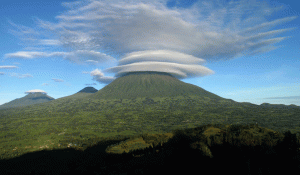 Volcanoes National Park is situated in the north-west of Rwanda, about 2 hours’ drive from Kigali City and bordering Mgahinga Gorilla National Park in south-western Uganda as well as Virunga National Park in the eastern Democratic Republic of Congo. This Park extends for an area of 160 square kilometers (16,000 hectares) of rainforest, Bamboo and Volcanoes… More
Mgahinga Gorilla National Park
 Mgahinga Gorilla Nation Park is found in Kisoro district, southwestern Uganda about 8-10 hours’ drive from Entebbe or Kampala and 4 hours’ drive from Kigali-Rwanda. Unlike other national parks in Uganda, this park is by far the only place where gold meets silver. The park covers an area of about 34 sq.kms and… Read More