
How Long Is the Nile River: Where it starts & Ends
How Long Is the Nile River: Discover how long the Nile River is, where it starts and ends, the countries it flows through, and fascinating facts about the longest river in Africa. Explore its history, wildlife, White Nile vs Blue Nile, and importance today.
The Nile River is one of the most iconic waterways on Earth. How long is the Nile River? It stretches approximately 6,650 kilometers (4,130 miles), making it the longest river in Africa and traditionally recognized as the longest in the world. This massive river has shaped civilizations, sustained ecosystems, and captured human imagination for millennia.
Flowing northward through northeastern Africa, the Nile River empties into the Mediterranean Sea. Its waters have nourished ancient empires, supported modern economies, and created a lifeline through some of the planet’s most arid landscapes. From its distant sources in the highlands and lakes of East Africa to the fertile delta in Egypt, the Nile remains vital for millions.
How Long Is the Nile River? Nile River Length Explained
The Nile River length is most commonly cited as 6,650 km (about 4,130 miles). Measurements can vary slightly—some sources list 6,695 km or even higher figures up to around 7,088 km—due to differences in where the river’s source is pinpointed, how meanders are accounted for, or which tributaries are included in the main stem.
How long is the Nile River in kilometers? Roughly 6,650 km. How long is the Nile River in miles? Approximately 4,130 miles. These figures establish it as Africa’s longest river and a contender for the world title.
The debate over whether the Nile or the Amazon is longer persists. Traditional measurements favor the Nile, but some Brazilian expeditions have claimed the Amazon exceeds it by measuring different headwaters or channels.
Most educational and geographic references still recognize the Nile as the longest or one of the two longest. The Nile vs. Amazon comparison highlights challenges in river measurement: starting points, seasonal changes, and mapping technology all influence results.
|
River |
Approximate Length |
Location |
|
Nile |
6,650 km |
Africa |
|
Amazon |
~6,400 km |
South America |
|
Yangtze |
~6,300 km |
Asia |
Where Does the Nile River Start and End? Source and Mouth of the Nile River
Where does the Nile River start? The Nile’s origins are complex, involving two major tributaries: the White Nile and the Blue Nile.
The White Nile is considered the primary headstream. Its furthest sources trace to rivers feeding Lake Victoria, Africa’s largest lake, shared by Uganda, Kenya, and Tanzania.
Some pinpoint even more distant origins in Burundi or Rwanda via the Kagera River system. The White Nile flows from Lake Victoria through Uganda and South Sudan.
The Blue Nile originates from Lake Tana in the Ethiopian highlands. It carries nutrient-rich silt and provides most of the Nile’s water volume, especially during seasonal floods.
Where does the Nile River start and end? The combined Nile begins properly at the confluence in Khartoum, Sudan, and flows northward through desert landscapes before ending in a vast delta on Egypt’s Mediterranean coast.
Where is the Nile River located? It lies entirely within northeastern Africa, traversing a variety of terrains from equatorial lakes to arid deserts.
White Nile vs Blue Nile: The Two Tributaries
Understanding the White Nile vs Blue Nile is key to grasping the river’s hydrology.
- White Nile: Starts from Lake Victoria region (Uganda/South Sudan area). Provides a steadier, year-round flow. Travels through swamps and lakes, resulting in clearer water.
- Blue Nile: Originates at Lake Tana in Ethiopia. Delivers the majority of water (often 55-60% or more) and fertile silt during the rainy season, causing the historic annual floods.
These two meet at Khartoum, creating the main Nile. The White Nile is longer in its path, but the Blue Nile is more volumetrically significant.
Countries the Nile River Passes Through
How many countries does the Nile River flow through? The river itself flows primarily through several, while its basin spans 11 countries: Burundi, Democratic Republic of the Congo, Egypt, Eritrea, Ethiopia, Kenya, Rwanda, South Sudan, Sudan, Tanzania, and Uganda.
Key countries along the main course include:
- Uganda (White Nile exit from Lake Victoria)
- South Sudan
- Sudan (confluence at Khartoum)
- Egypt (longest navigable section and delta)
Nile River in which country? While strongly associated with Egypt, it is a shared resource across East and North Africa. Nile Basin countries cooperate (and sometimes dispute) water management through initiatives like the Nile Basin Initiative.
Nile River Map and Visualizing the River
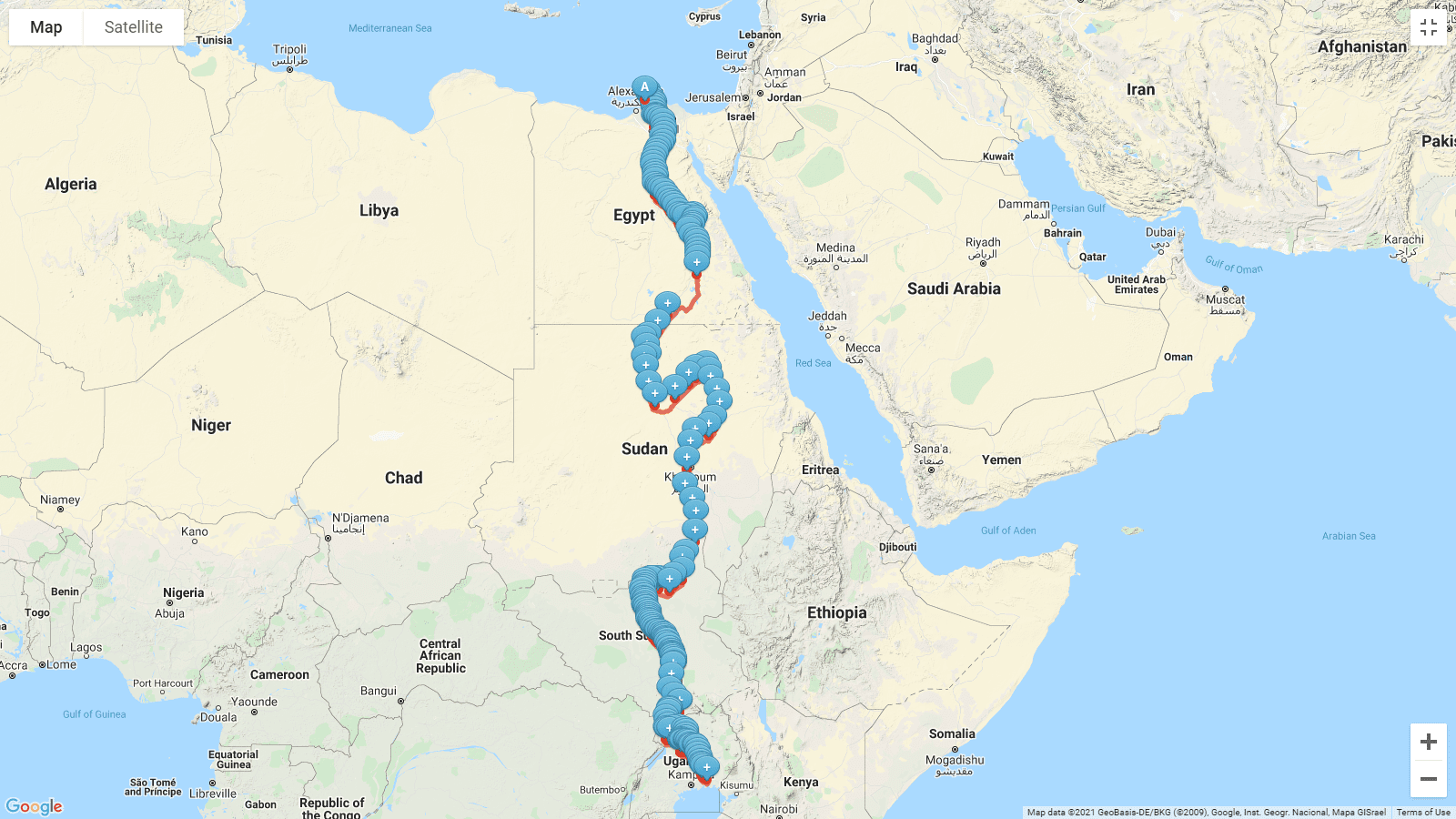
A Nile River map typically shows the river flowing north from near the equator to the Mediterranean, with the White Nile branch from Lake Victoria and Blue Nile from Ethiopia joining in Sudan.
Satellite images reveal the striking green ribbon of vegetation through the Sahara Desert in Egypt. River basin maps highlight the vast drainage area of over 3 million square kilometers.
Why the Nile River Is Important
The Nile’s significance cannot be overstated. It provides agriculture (irrigation for crops like cotton, wheat, and sugarcane), drinking water, transportation, hydroelectric power (dams like Aswan High Dam), tourism, and wildlife habitats. Over 95% of Egypt’s population lives near its banks.
Modern economies depend on it for food security and energy. Ancient civilizations thrived because of its predictable floods that deposited fertile silt.
The Nile River in Ancient History
The Nile River was the cradle of Ancient Egyptian civilization. Egyptians called it Ar or “black” for the dark, fertile soil. Annual floods enabled farming in the desert, supporting a sophisticated society with cities, pyramids, and trade.
It served as a highway for transportation, a source of fish and papyrus, and a central element in mythology (associated with gods like Hapi). Trade routes along the Nile connected Africa and the Mediterranean.
How old is the Nile River? Geologically, its current course is relatively young—around 15,000 years in its present form—though the Nile system has ancient precursors.
Wildlife Along the Nile River
The Nile supports rich biodiversity:
- Nile Crocodile — One of the largest crocodilians, growing up to 6 meters.
- Hippopotamus — Common in swamps and slower sections.
- Fish species like Nile perch (which can exceed 100 kg), tilapia, and catfish.
- Birds, including migratory species using the river as a flyway; turtles, snakes, and monitor lizards.

Tourist Attractions Along the Nile River
Nile cruises are hugely popular, especially in Egypt between Luxor and Aswan. Attractions include:
- Murchison Falls in Uganda.
- Jinja area near Lake Victoria (whitewater rafting).
- Aswan, with its islands and High Dam.
- Cultural sites, temples, and national parks.
Fishing, birdwatching, and cultural tourism thrive along its length.
Interesting Facts About the Nile River
- It flows northward, against the typical “south to north” expectation many have for African rivers.
- It crosses vast deserts yet remains perennial.
- It supported one of the world’s earliest great civilizations.
- Contains two major tributaries with distinct characters (White vs Blue).
- Its delta is one of the largest in the world.
- Home to unique ecosystems and species adapted to its rhythms.
How deep is the Nile River? Depth varies widely—from shallow sections in swamps to over 10-20 meters in parts of the main channel, though averages are much less.
Environmental Challenges Facing the Nile River
The Nile faces pollution, climate change impacts on rainfall and evaporation, dam construction (notably the Grand Ethiopian Renaissance Dam on the Blue Nile, which has caused water-sharing disputes), and overuse.
Population growth intensifies pressure on this finite resource. Conservation efforts focus on sustainable management across borders.
FAQs About the Nile River
How long is the Nile River in miles? Approximately 4,130 miles.
Where does the Nile River begin? From the Lake Victoria region (White Nile) and Lake Tana (Blue Nile).
Which country has the longest section of the Nile? Often Egypt or Sudan, depending on exact measurements.
Is the Nile longer than the Amazon? Traditionally yes, though debated.
Why is the Nile River important? It sustains life, agriculture, economies, and history across multiple countries.
What animals live in the Nile? Nile crocodiles, hippos, various fish, birds, and more.
Can tourists visit the Nile River? Absolutely—cruises, safaris, and sites are accessible.
What are the two main tributaries of the Nile? White Nile and Blue Nile.
The Nile River continues to be a symbol of resilience and life in Africa. Its length, history, and ongoing importance make it a treasure worth understanding and protecting. Whether exploring its sources, cruising its waters, or studying its ancient legacy, the Nile offers endless fascination.